It is one of the important functions of GIS to find hidden information by classification. Compared with the traditional map, the data on the map has been specially classified and processed, while the data stored in GIS has the nature of original data, so the data can be classified and extracted according to different needs. Because this classification is the reorganization of the original data, it is called Reclassification.
GIS differs from other information systems in its processing function of spatial information, and also provides the processing function of non-spatial attributes. Although it is relatively simple, it plays an important role in practical application. According to the non-spatial attributes of geographic information, such as material, value, nature of use and so on, the classification based on non-spatial attributes is the same as other information systems in classifying simple structured data. Classical mathematical statistics methods can be used, such as principal component analysis, hierarchical analysis, clustering analysis, discriminant analysis and so on. This kind of classification belongs to the common classification, it does not change the existing attribute values of the objects, but only divides them into the corresponding categories according to the attributes of the objects. This chapter mainly discusses the re-classification of new features generated by classification organization through the attribute information of ground objects in GIS.
The reclassification of points and linear features can be realized by simply modifying the values in the attribute table for the vector data structure. For the raster data structure, the new points and line features can also be obtained by modifying the attribute values, the reclassification of the planar features, for the raster data structure, is the same as the point and line classification, simply changing the attribute values and changing the legend performance. For example, there is a raster map with attribute values from 1 to 15 representing a crop, if 1 to 5 and 13 are food crops, others represent cash crops, 1 to 5 and 13 can be reassigned 1 and the other numbers are assigned 2, a raster map of only two types of food crops and cash crops can be obtained, and the legend is changed to reflect this change. For the reclassification of planar features of vector data structures, it is necessary to change the geometry and properties of the entities at the same time. The first task is to remove the line between the polygons to be merged and then change the attribute values of the two polygons to the same attribute. As shown in Figure 8-4: Fig. 113 Merging Polygons # 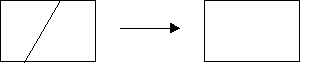
Because the new layer has fewer categories than the original layer, it is called Group, which is the most commonly used and simplest re-classification. If you want to further decompose the area figure into different types of figures, you can not use this method, because you can not know the location of the boundary, you can use another layer, through the polygon overlay method.
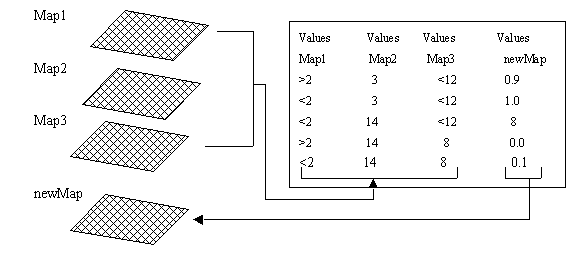
The above-mentioned reclassification methods are based on the attributes of the surface objects themselves, and achieve the purpose of classification by re-changing the attribute values. Of course, they can also be re-classified by combining the attribute values of the neighborhood range. For example, slope calculation and buffer calculation. Reclassification can also synthesize attribute information of multiple layers, as shown in Figure 8-5. Fig. 114 Reclassification of multiple attributes #