
HTML5 is the latest revised version of HTML, which was developed by the World wide Web Consortium (W3C) in October 2014.
HTML5 is designed to support multimedia on mobile devices.
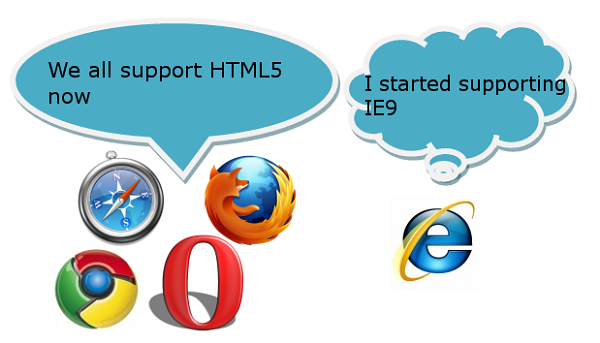
HTML5 is easy to learn. HTML5 is the next generation HTML standard. The last version of HTML, HTML 4.01 was born in 1999. Since then, the Web world has undergone great changes. HTML5 is still in the process of improvement. However, most modern browsers already have some HTML5 support. HTML5 is the result of cooperation between W3C and WHATWG, and WHATWG refers to Web Hypertext Application Technology Working Group. WHATWG focuses on web forms and applications, while the W3C focuses on XHTML 2.0. In 2006, the two sides decided to work together to create a new version of HTML. Some interesting new features in HTML5: Used for painting. For media playback Better support for local offline storage New special content elements, such as article, footer, header, nav, section New form controls, such as calendar, date, time, email, url, search The Here is a simple HTML5 document: Note: for Chinese pages, you need to use New element New attribute Full support for CSS3 Video and Audio 2D/3D mapping Local Stora Local SQL data Web application With HTML5 you can simply play video (video) and audio (audio) on a web page. HTML5 HTML5 You can simply develop applications with HTML5 Local data storage Access local files Local SQL data Cache reference Javascript worker XHTMLHttpRequest 2 You can simply draw graphics with HTML5: Use Use inline SVG. Use CSS3 2D conversion, CSS3 3D conversion. New selector New attribute Animation 2D/3D conversion Fillet Shadow effect Downloadable font HTML5 adds a number of semantic elements as follows: Label Description < article > Define the independent content area of the page. < aside > Define the contents of the sidebar of the page. < bdi > Allows you to set a piece of text away from the text orientation setting of its parent element. < command > Define command buttons, such as radio buttons, check boxes, or buttons < details > Used to describe the details of a document or a part of a document < dialog > Define a dialog box, such as a prompt box < summary > The tag contains the title of the details element <figure> Specify independent streaming content (images, charts, photos, codes, etc.). < figcaption > Define the title of the < figure > element < footer > Define the footer for section or document. < header > Defines the header area of the document < mark > Defines marked text. < meter > Define weights and measures. Used only for measurements of known maximum and minimum values. < nav > Define the part of the navigation link. < progress > Define the progress of any type of task. < ruby > Define ruby comments (Chinese phonetic or character). < rt > Define the interpretation or pronunciation of characters (Chinese Bopomofo or characters). <rp> Used in ruby comments to define what is displayed by browsers that do not support ruby elements. < section > Define sections in the document. < time > Define the date or time. < wbr > Specifies where to add newline characters in the text. New form elements, new attributes, new input types, automatic validation. The following HTML 4.01elements have been deleted in HTML5: < acronym > < applet > < basefont > < big > < center > < dir > < font > <frame> < frameset > < noframes > < strike > With our HTML editor, you can edit the HTML and click the button to see the results. The latest versions of Safari, Chrome, Firefox, and Opera support certain HTML5 features. Internet Explorer 9 will support some HTML5 features. The following versions of IE9 browsers are compatible with HTML5 methods and use the static resources of this site After loading, initialize the CSS of the new tag: 11.30.1. What is HTML5? 
11.30.2. How did HTML5 start? 
canvas
element
video
and
audio
element 11.30.3. HTML5 <! DOCTYPE > 
<!doctype>
declaration must be on the first line of the HTML5 document, and it is very simple to use:<!DOCTYPEhtml>
11.30.4. The smallest HTML5 document 
<!DOCTYPEhtml><html><head><metacharset="utf-8"><title>document title</title></head><body>document content......</body></html>
      <meta
      charset="utf-8">
declare the code, otherwise there will be garbled. 11.30.5. Improvement of HTML5 
11.30.6. HTML5 multimedia 
<video>
<audio>
11.30.7. HTML5 application 
11.30.8. HTML5 graphics 
<canvas>
element. 11.30.9. HTML5 uses CSS3 
11.30.10. Semantic element 
11.30.11. HTML5 form 
11.30.12. Element removed 
11.30.13. Examples in each chapter 
Example 
<!DOCTYPEHTML><html><head><meta charset="utf-8"> <title>
Rookie Tutorial(runoob.com)</title> </head><body><videowidth="320"height=
"240"controls><sourcesrc="movie.mp4"type="video/mp4"><sourcesrc=
"movie.ogg"type="video/ogg">Your browser does not support
video tags.</video></body></html>
11.30.14. HTML5 browser support 
html5shiv
package:<!--[if lt IE 9]> <script
src="http://cdn.static.runoob.com/libs/html5shiv/3.7/html5shiv.min.js"></script>
<![endif]-->
/\*html5\*/article,aside,dialog,footer,header,section,nav,figure,menu{display:block}