Perl
conditional statement is the result of the execution of one or more statements
True
or
False
to determine the block of code to execute
You can use the following figure to briefly understand the execution of conditional statements: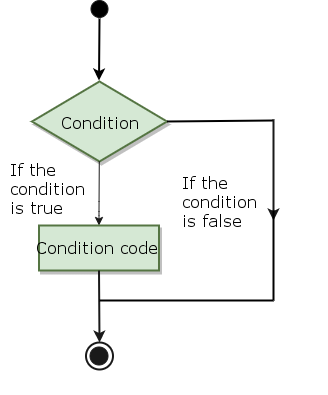
Note that the number 0, string
'0'
、
""
, empty
list()
, and
undef
for
false
all other values are
true
.
true
previous use
!
or
not
then return to
false
.
Perl
provide the following conditional statements are provided:
Statement | Description |
|---|---|
If statement | An if statement consists of a Boolean expression followed by one or more statements. |
If…else statement | An if statement can be followed by an optional else statement, and the else statement is executed when the Boolean expression is false. |
If…elsif…else statement | You can follow an if statement with an optional elsif statement, followed byanother else statement. |
Unless statement | A unless statement consists of a Boolean expression followed by one or more statements. |
Unless…else statement. | An unless statement can be followed by an optional else statement. |
Unless…elsif..else statement | An unless statement can be followed by an optional elsif statement, followedby another else statement. |
Switch statement | In the latest version of Perl, we can use the switch statement. It executes the corresponding block of code according to different values. We can use conditional operations If The example is as follows: Execute the above program, and the output is as follows:
Principles, Technologies, and Methods of Geographic Information Systems 102 In recent years, Geographic Information Systems (GIS) have undergone rapid development in both theoretical and practical dimensions. GIS has been widely applied for modeling and decision-making support across various fields such as urban management, regional planning, and environmental remediation, establishing geographic information as a vital component of the information era. The introduction of the “Digital Earth” concept has further accelerated the advancement of GIS, which serves as its technical foundation. Concurrently, scholars have been dedicated to theoretical research in areas like spatial cognition, spatial data uncertainty, and the formalization of spatial relationships. This reflects the dual nature of GIS as both an applied technology and an academic discipline, with the two aspects forming a mutually reinforcing cycle of progress.
|