As long as the given condition is In Scala language the Here, Here, the The output result of executing the above code is:
true
in the Scala language
while
loop statement repeats the block of code inside the loop. 8.11.1. Grammar #
while
syntax of the loop:while(condition)
{
statement(s);
}
statement(s)
can be a single statement or a block of code madeup of several statements.
condition
can be any expression, or when it is any non-zero value
true
. When the condition is the
true
loop is executed when the. When the condition is
false
to exit the loop, and the program flow continues to execute the next statement immediately following the loop. 8.11.2. Flow chart #
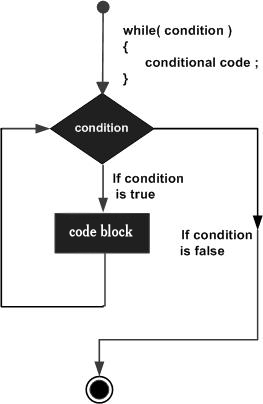
while
key point of a loop is that the loop may not be executed at all. When the condition is
false
skips the loop body and directly executes the following the
while
next statement of the loop. 8.11.3. Example #
Example #
object Test {
   def main(args: Array[String]) {
      // local variable
      var a = 10;
      // while Recurrent execution
      while( a < 20 ){
         println( "Value of a: " + a );
         a = a + 1;
      }
   }
}
$ scalac Test.scala
$ scala Test
value of a: 10
value of a: 11
value of a: 12
value of a: 13
value of a: 14
value of a: 15
value of a: 16
value of a: 17
value of a: 18
value of a: 19