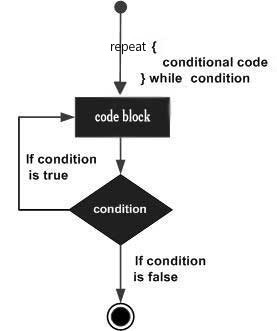
Swift Swift Notice that the conditional expression appears at the end of the loop, so the If the condition is The number 0, the strings’0’ and’’, empty Flow chart: The output of the above program execution is as follows:
repeat...while
the cycle is not like
for
and
while
the loop judges the conditional statement before the loop body starts execution,but determines whether the condition is met at the end of the loop execution. 9.20.1. Grammar #
repeat...while
the syntax format of the loop is as follows:repeat
{
statement(s);
}while( condition );
statement(s)
will be executed at least once before the conditionis tested.
true
the control flow will jump back to the above
repeat
and then re-execute the
statement(s)
. This process is repeated over and over again until a given condition becomes
false
so far.
list()
and undefined variables are
false
and the rest are
true
.
true
use it backwards! Number or
not
, take the reverse and return
false
.
9.20.2. Example #
import Cocoa

var index = 15

repeat{
    print( "The value of index is \(index)")
    index = index + 1
}while index < 20
The value of index is 15
The value of index is 16
The value of index is 17
The value of index is 18
The value of index is 19