The judgment structure requires the programmer to specify one or more conditions to be evaluated or tested, as well as statements to be executed if the condition is true (required) and statements to be executed if the condition is false (optional).
The following is a general form of a typical judgment structure in most programming languages:
C # provides the following types of judgment statements. Click the link to see the details of each statement. Statement Description If statement An if statement consists of a Boolean expression followed by one or more statements. If…else statement An if statement can be followed by an optional else statement, and the else statement is executed when the Boolean expression is false. Nested if statement You can use another if or else if statement within one if or else if statement. Switch statement A switch statement allows you to test when a variable is equal to multiple values. Nested switch statement You can use another switch statement within another switch statement. We have explained the conditional operator in the previous chapter Among them 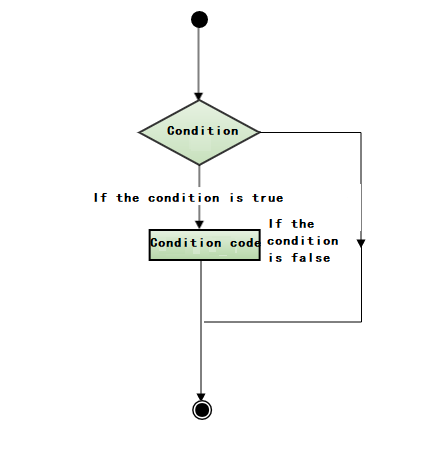
1.10.1. Judgment sentence #
1.10.2.
?
:
Operator #
?
:
, which can be used instead of the if…else statement. Its general form is as follows:Exp1 ? Exp2 : Exp3;
Exp1
、
Exp2
and
Exp3
is an expression. Please notethe use and location of colons.
?
value of the expression is determined by the
Exp1
. It was decided. If
Exp1
is true, calculate
Exp2
. The result is the entire
?
value of the expression. If
Exp1
is false, it is calculated
Exp3
, the result is the entire
?
value of the expression.