In programming When The flow chart is as follows: Use The result of the above code execution is:
if
statement, you can use the optional
else
statement,
else
expression in the statement is the Boolean expression
false
when it is executed. 2.19.1. Grammar #
Go
language the syntax of the
if...else
statement is as follows:If Boolean expression {
/* Execute when Boolean expression is true */
} else {
/* Execute when Boolean expression is false */
}
If
is in a Boolean expression of
true
, the block of statements immediately following the execution of the
false
then execute `` else``sentence block.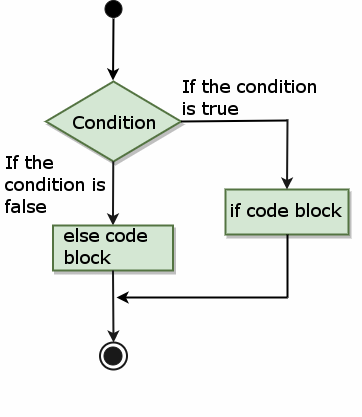
2.19.2. Example #
      if
      else
to judge the size of a number:Example #
package main
import "fmt"
func main() {
   /* Definition of Local Variables */
   var a int = 100;

   /* Judging Boolean Expressions */
   if a < 20 {
       /* If the condition is true, execute the following statement */
       fmt.Printf("A less than 20\\n" );
   } else {
       /* If the condition is false, execute the following statement */
       fmt.Printf("A not less than 20\\n" );
   }
   fmt.Printf("The value of a is: %d\\n", a);
}
A not less than 20
The value of a is: 100