HTML5 can be used in documents
MathML
element, the corresponding label is
<math>...</math>
.
MathML is a mathematical markup language, which is based on XML (a subset of the standard general markup language). It is used to write mathematical symbols and formulas on the Internet.
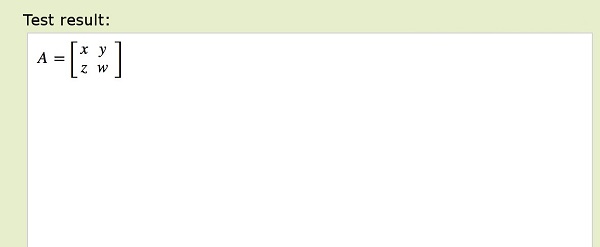
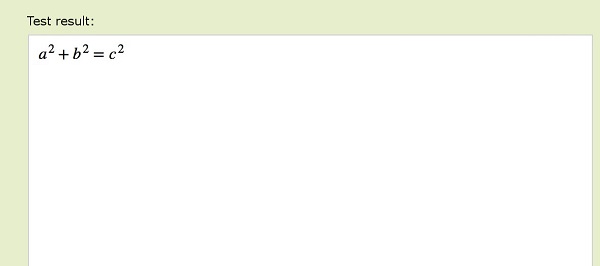
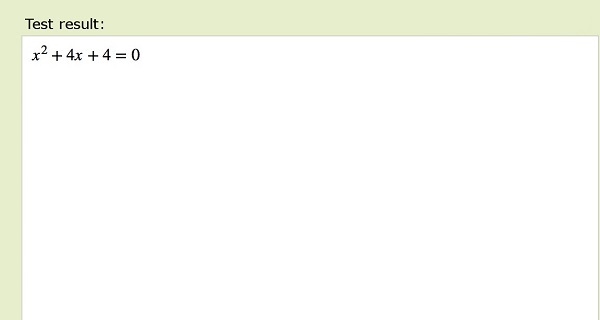
Note: most browsers support the MathML tag. If your browser does not support this tag, you can use the latest version of Firefox or Safari browser to view it. Here is a simple example of MathML: Run the result diagram, as shown below: The following example adds some operators: Run the result diagram, as shown below: The following example is a 2 × 2 matrix, which can be seen in Firefox 3.5 or above: Run the result diagram, as shown below: 11.35.1. MathML instance 
Example 
<!DOCTYPE html>
<html>
   <head>
      <meta charset="UTF-8">
      <title>Rookie Tutorial(runoob.com)</title>
   </head>

   <body>

      <math xmlns="http://www.w3.org/1998/Math/MathML">

         <mrow>
            <msup><mi>a</mi><mn>2</mn></msup>
            <mo>+</mo>

            <msup><mi>b</mi><mn>2</mn></msup>
            <mo>=</mo>

            <msup><mi>c</mi><mn>2</mn></msup>
         </mrow>

      </math>

   </body>
</html>
Example 
<!DOCTYPE html>
<html>
<head>
<meta charset="UTF-8">
<title>Rookie Tutorial(runoob.com)</title>
</head>
<body>
<math xmlns="http://www.w3.org/1998/Math/MathML">
<mrow>
<mrow>
<msup>
<mi>x</mi>
<mn>2</mn>
</msup>
<mo>+</mo>
<mrow>
<mn>4</mn>
<mo></mo>
<mi>x</mi>
</mrow>
<mo>+</mo>
<mn>4</mn>
</mrow>
<mo>=</mo>
<mn>0</mn>
</mrow>
</math>
</body>
</html>
Example 
<!DOCTYPE html>
<html>
   <head>
      <meta charset="UTF-8">
      <title>Rookie Tutorial(runoob.com)</title>
   </head>

   <body>
      <math xmlns="http://www.w3.org/1998/Math/MathML">

         <mrow>
            <mi>A</mi>
            <mo>=</mo>

            <mfenced open="[" close="]">

               <mtable>
                  <mtr>
                     <mtd><mi>x</mi></mtd>
                     <mtd><mi>y</mi></mtd>
                  </mtr>

                  <mtr>
                     <mtd><mi>z</mi></mtd>
                     <mtd><mi>w</mi></mtd>
                  </mtr>
               </mtable>

            </mfenced>
         </mrow>
      </math>

   </body>
</html>